Showing posts with label Baking Arts. Show all posts

Sunday, 25 May 2014

Week 9: Chiffon Cheesecake

Cakes 1 is almost coming to an end...only one class left :( ...but at least this wasn't the very last class :)

This week we learned a new twist on cheesecake!  I'm a big cheesecake fan and am always ready to pull out my spring form pan and make a cheesecake when asked to make dessert for an event, so it was nice to learn a new way of making it, from my traditional new york style cheesecake.

New york style cheesecake, can be very dense and rich, but this cake was much lighter, allowing me to eat a lot more cheesecake than I usually can :p.  The cake was lightened with the addition of whipped egg whites which adds a lot of airiness.  In the which chocolate raspberry cheesecake I've made in the past, the filling was really simple, white chocolate, cream cheese, cream and sugar, but this cake had 6 eggs, flour, buttermilk and oil, making it much more cake like in consistency.  

The crust was a traditional graham cracker crust, which is super easy to make, just melted butter, graham cracker crumbs and sugar, but we added some toasted ground almonds to heighten the flavour :)

For the topping, we cooked down some frozen raspberries with sugar, water and cornstarch to thicken it up. 


Saturday, 3 May 2014

Week 8: Chocolate Mousse Cake

Another fun week in Cakes 1 :)  This week we made a chocolate mousse cake, surprisingly our first chocolate cake of the course.
This cake was layers of almond meringue (Japonaise) with a chocolate mousse filling covered in a chocolate glaze, it was light with a good chocolate flavour.

The cake got it's lightness from the airy meringue and silky smooth mousse.  The mousse was mainly whipped cream but also had whipped eggs with sugar, melted chocolate with butter and a little bit of gelatin for stability. 

Once the meringue was baked and cooled, it was layered together in a ring mold and placed in the blast chiller.  After a little while, it was time for the fun part, the glazing :)  I decided to cover the entire cake in chocolate and decorate with extra meringue bits and chocolate covered crunch balls.

I'm not usually a chocolate cake person, but this was really good, since it wasn't too dense and rich. 

Sunday, 23 February 2014

Week 4: Orange Chiffon Cake

Yay! Orange Chiffon Cake! A first for me :)  I've never made this type of cake before, so it was nice to learn something new.  We started the class with a demo on how to make Angel food cake followed by making the Orange Chiffon cake.

Angel food cake seems simple to make, but doesn't have much flavour.  I think if I was to serve it, I'd plate it with a raspberry or strawberry sauce and whipped cream.  It needs to be served with something since the batter is not really flavoured with anything, it's just egg whites, sugar, flour and a little bit of vanilla.  The texture is nice though, its very light and airy.

It gets its airiness from whipping the egg whites to soft peaks, whipping in the sugar and then gently folding in the dry ingredients.  Keeping lots of air in the batter allows for the cake to be very light.  

Orange chiffon cake is similar to angel food cake, but it also has egg yolks, oil and obviously, orange zest :)  Adding the extra fat with the egg yolks and oil makes the cake richer, but it is still light from the whipped egg whites.  When the instructor made it, she admitted that she over whipped the egg whites, until they were dry stiff peaks.  This resulted in a chewy porous cake.  When you make this, you have to be very careful with the egg whites since their texture can drastically change the cake's texture.

I learned some new tips in this class :)  If you need to whip egg whites and you don't have enough time to let your eggs come to room temperature, place them in hot tap water for a few minutes to warm them up.  Also, to make sure your bowl is clean and has no trace of oils before you whip the egg whites, rub the bowl with a little lemon juice.  A clean non-plastic bowl and room temperature eggs will make sure the egg whites whip up well.


For the glaze, we juiced the orange which we previously zested for the cake and added icing sugar...super simple! I drizzled it over the cake and voila!


Saturday, 1 February 2014

Week 2: Carrot Cake


So I've signed up for another baking course at George Brown College...I'm taking Cakes 1 :)

I missed the first week, where they learned how to make pound cake.  That would've been good to
learn, since I don't really know the difference between pound cake and butter cake, but oh well, at least I have a new recipe to try.

This week was carrot cake.  It was interesting to learn how to make it in a new way.  I've always made carrot cake using butter and/or oil and adding pineapple for moistness but this recipe didn't call for either.  This recipe called for heating eggs and sugar over a water bath, then whipping them to soft peaks.  Then gently folding in the grated carrots and flour by hand.  We had to be very careful not to over mix, since it is really easy to lose volume at this point.


The icing was a cream cheese icing made with quark folded into whipped cream.  I'd never heard of quark before, but apparently it's a pure form of cheese, unlike the usual cream cheese we buy from the grocery store.  We had to beat the quark until it was smooth before folding in the cream and this took quite a while.  We had to be really patient with it to make sure we got a creamy smooth icing, free from any quark lumps.  


To decorate, I tinted marzipan orange, then rolled it by hand to look like mini carrots.  Using the dull side of a knife, I made lines on the marzipan to make it look more real, then piped green piping gel on the tips. :)


Using an icing comb, I made ridges on the side  of the cake and then added a small almond border to the bottom.


The end result was quite tasty and light for a carrot cake.  I will definitely use this recipe again. 

Thursday, 4 July 2013

Week 12: Strawberry Shortcake

It was the final week :( I'm really going to miss class and baking every Wednesday.  I've learned a lot, so I'm definitely going to take more classes, just not sure which ones yet, maybe Cakes I, Pies or Pastry?

The "Strawberry Shortcake" we made this week was really more of a yellow sponge cake with strawberries and cream, since traditional strawberry shortcake is more of a biscuit with the strawberries and cream.  Even though we made a simpler version of the traditional cake, it still turned out pretty nicely. 

We started out making the cake, which was an egg foam batter, similar to the swiss roll recipe.  I learned from the swiss roll that egg foams can tend to be a little dry, so I made sure I remembered to use lots of simple syrup when layering.

While the cakes were baking, we made whipped cream, sliced strawberries and dipped strawberries in chocolate.  Once the cakes were baked and placed in the blast chiller for a few minutes, we cut each cake into 3 layers and started layering.

The layers were yellow sponge covered in rum flavoured simple syrup, a thin layer of whipped cream and then an even layer of sliced strawberries.

We decorated the cake similarly to the black forest but learned to use a comb on the side.  The metal comb was used to create ridges.  The comb is kind of tricky to use as you need to have a thick coating of cream on the side so when you pull the comb through, you don't see cake, but when there is too much cream, it makes it a little difficult to the make the ridges look even.


Since class has ended and it may be a little while until I take another one, I will keep baking and posting about what I make...so feel free to make suggestions on things you would like to see :) Thanks for reading!

Thursday, 27 June 2013

Week 11: Fruit Flan Tart

This week was fruit flan tarts.  The class ran a little differently since we had a substitute instructor.  Our instructor for the day usually teaches apprentices and ran the class on a much stricter schedule.  She had set times for demos and was very particular that our tarts look professional.  Here's how it went...

We actually started this a few weeks ago during cookie week.  We made the tart crust in advance so it would have time to chill.

A trick the instructor taught us is when you are going to put anything in the freezer that you want to eventually defrost, flatten it out first so that it'll thaw out quicker.

While the crust was thawing, I started on the pastry cream.  I boiled the milk, sugar and vanilla bean for a while.  To start, I used a rinsed saucepan since the water helps the milk not to burn.

I tempered the eggs and cornstarch with the hot milk then brought everything back to a boil while continuously whisking.  Once it had thickened, I cooled it in the fridge and started rolling out the dough for the crust.

I rolled it fairly thin and placed it into shells.  I covered it with plastic wrap and filled them with navy beans.  The navy beans could be replaced with almost anything dry.  They are there to make sure the tart shell doesn't collapse on itself while baking or puff up too much.

Once the shell had finished blind baking for a few minutes.  I removed the beans and chilled the shells briefly and then coated the insides of the tart with melted white chocolate.  The white chocolate helps prevent the bottom from becoming soggy.


I whipped the chilled pastry cream again and filled the tarts.  After slicing fruit, I arranged them on the top then brushed some apricot glaze on the top.  There was an option for sliced almonds as well, but I decided to go simple this time.


Thursday, 20 June 2013

Week 10: Chocolate Swiss Roll


It was another busy week with the chocolate swiss rolls.  I had a substitute partner this week, who was there from another class, so it was nice to share the workload.


The cake part of this recipe was fairly simple with only 4 ingredients: eggs, sugar, cocoa and flour.  We started by making an egg foam with the eggs and sugar, this was whisked until it really increased in volume.  The flour and cocoa was folded in by hand to ensure the egg foam didn't deflate or over mix.

With an egg foam batter, it is important to work quickly as the batter is continuously deflating until it is in the oven.

The batter was baked on a large sheet pan covered in parchment paper.  Baking a thin cake allows for easy rolling but I also think it leads to the cake baking slightly dry, but this can be fixed with lots and lots of simple syrup.

Next was the chocolate glaze.  We boiled some heavy cream with glucose and added that to dark chocolate.  The glucose was added to make the chocolate glossy.  This was set aside to cool while we made the Italian chocolate buttercream to go inside the roll.

The buttercream was my favourite part!  I'm never going back to the standard American Buttercream made with just butter and icing sugar again.

With Italian buttercream, since the sugar is cooked and slowly added to the whipped egg whites, the icing turns out much smoother.  Adding lots of butter, makes it very silky.

Before spreading the icing, I brushed a heavy amount of brandy flavoured simple syrup over the entire cake to keep it moist.  The buttercream was spread fairly thinly over the cake, but next time, I will spread it even thinner since it makes the rolling much easier.


I sprinkled a few raspberries and toasted hazelnuts inside, then rolled up the cake.  Once I made the rolling as tight as possible, I masked it with more buttercream :)  Last step was to drizzle chocolate glaze on top and decorate with chocolate accents, raspberries and hazelnuts.


Since I made the mistake of piping buttercream onto chocolate glaze that wasn't fully cooled, my buttercream rosettes slipped off of one of the swiss rolls and I had to redecorate.  This is how it turned out...


Thursday, 13 June 2013

Week 9: Black Forest Cake


This was a busy week, since it was our first week making an entire cake.  We baked the cake, torted, filled, masked and decorated it. 

I found out that my partner has dropped the class, but another person was partnerless for the day, so we paired up.  As a pair, we made three devil's food cakes.  One each and a spare incase something went wrong.

Devil's food cake is just a special name for moist chocolate cake.  The recipe was straight forward and yeilded 3 - 7 inch rounds.  Once the cakes were baked, we immeditely flipped them out of the pans onto cake rounds and put them into the
blast chiller.

While the cakes were cooling, we made the whipped cream for the icing.  We had the choice of using commerical grade whipped topping (what we used in Week 4), whipping cream, or a mixture of both.  I chose to use mainly whipping cream with a little bit of whipped topping for sweetness and stability.

When the cakes were sufficiently cooled, we leveled the top of the cake, cut it into 3 layers (torted) and brushed each layer with a kircsh flavoured simple syrup.  This helps keep the cake moist and adds more flavour.

We piped multiple concentric rings of icing on each layer and filled the gaps with cherry filling.  This was done twice and the top layer was inverted to get a level top.  We used a ready made cherry filling, but if I was to do this again, I would make it from scratch.          

Then it was time to mask the cake.  We didn't actually spend too much time on this step as most of the cake was going to be covered anyways.  A big block of chocolate circulated around the room and we each used our knives to make chocolate shavings.

Since our spare cake turned out well, we decided to decorate it as well and each take home half.  Here's how it turned out:

It's too bad my half didn't last the drive home...oh well, I think it still tasted good. 


Thursday, 6 June 2013

Week 8: Cookies


This week was all about cookies.  I showed up early to class to scale the ingredients, just to find out into the class that my partner wasn't coming, so looks like I'm doing double the work, but that also means double the cookies for me :)


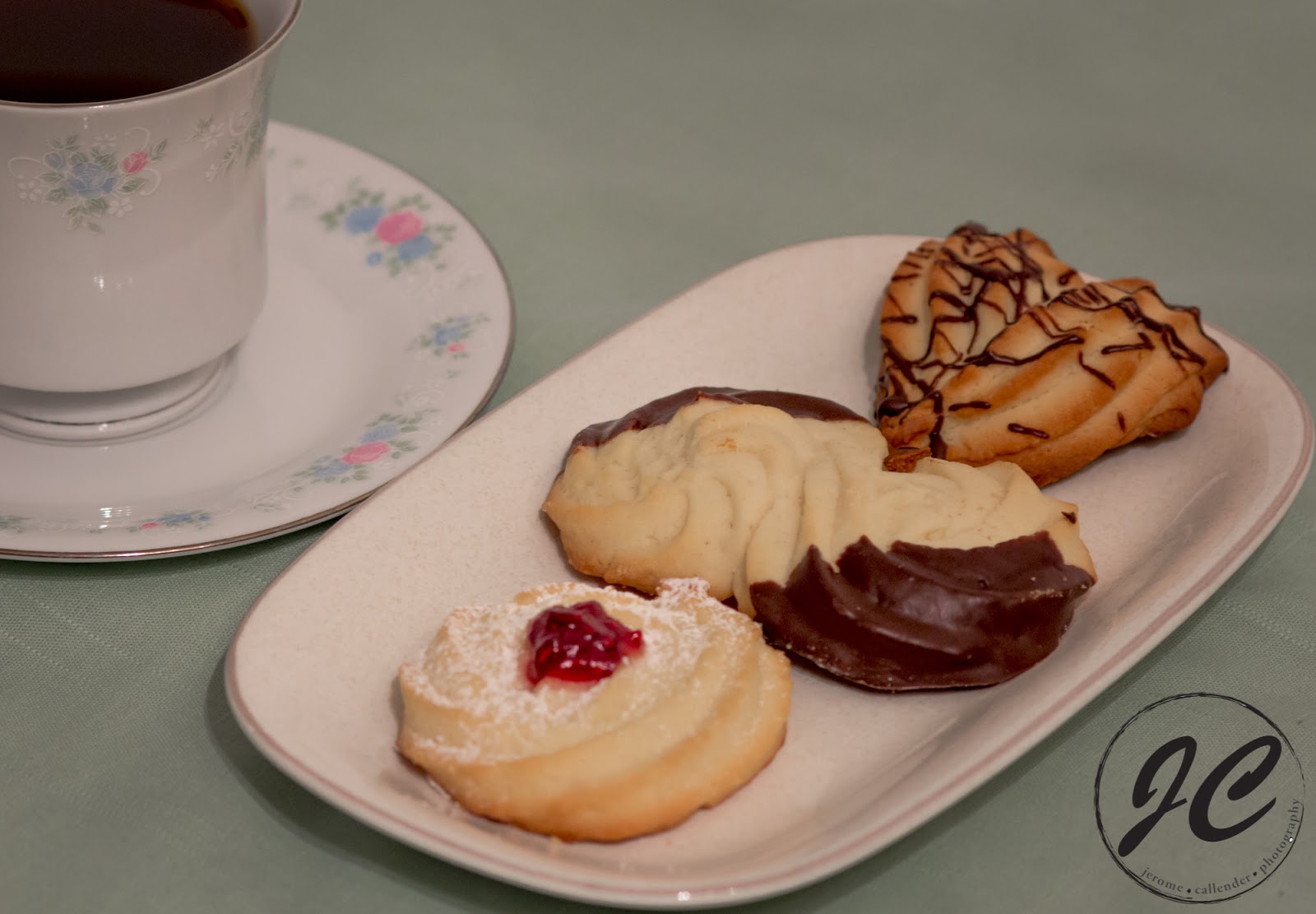
We learned how to make spritz cookies, which are named after the German word spritzen which means to squirt.  The cookie dough is made but then piped(squirted) out of a piping bag.  The dough was pretty basic, a mixture of butter, shortening, icing sugar, flour, vanilla, eggs and lemon zest.


We learned that icing sugar often contains corn starch which helps make whatever you are making, melt in your mouth while preventing it from caking, which is good for this shortbread like cookie.  Also, letting any type of zest sit in sugar before incorporating helps bring out the flavour and oils in the zest.


If I was to make this again, I think I would add more lemon zest or some other flavouring and substitute all butter for the shortening as that gives it a better flavour.


With this dough, we piped it into various different shapes and once finished, decorated with chocolate different ways as well.  We also had the choice of making sandwich cookies with jam in the middle and obviously I decided to make some of those too :)  When I got home, I made some more sandwiches with Nutella, who doesn't love that stuff!

Wednesday, 29 May 2013

Week 7: Eclairs and Cream Puffs

This week we got back to sweet stuff by making eclairs and cream puffs!  They are both made with the same batter just piped and decorated differently.

They were fairly simple to make, just very time consuming as you actually cook the flour mixture before piping it and putting it in the oven.  The flour is cooked in a boiled butter and water mixture until it forms a film on the bottom of the pot, then transferred to a mixer where the eggs are added slowly.  This mixture is piped out into either rosettes or lady finger (cream puffs or eclairs, respectively).  The batter has a very eggy flavour, but that doesn't matter since it's really all about the filling or chocolate on top :)


Once baked, the rosettes and lady fingers are hollow and easy to pipe.  You can either pipe it into the side/bottom or just cut off the top and pipe inside.  With the eclairs, we watered down pourable chocolate fondant, dipped the lady fingers inside and filled with whipped cream.  For the rosettes, I filled it with raspberry jam and more whipped cream :)


I think I will be making this recipe again!


Friday, 24 May 2013

Week 6: Bread


This week we did something different, we moved away from sweet things to bread!  We learned how to make different types/styles of bread with the same dough.

To make the dough, we used fresh yeast, something I'd never seen before.  It has a crumbly, slightly gross texture that comes in blocks like butter and smells not so pleasant.  This yeast can be found at many bakeries, but not readily in grocery stores.  Fresh yeast has a better flavour than dry yeast, but they can be substituted for each other using a formula.

To keep the yeast alive, it's important to add the right temperature warm water and have some kind of fuel for it, in our case, sugar.  Once the dough was mixed, we kneaded it for a while and covered it with plastic and a metal bowl to seal in all the warmth.  Once the dough had doubled in size, we pressed some of the air out, cut it up and formed it into balls.

We then used about 7 of these balls to make cheesy monkey bread :)  This is done by placing the formed balls in a greased cake pan, covering it with cheese and herbs, proofing and then baking.  It bakes together but pulls apart easily.

With the remainder of the dough, we made various rolls.  We learned how to make buns, knots and braids.  Since these were smaller and were going to be baked individually, they didn't need to be proofed and went straight into the oven after a covering of poppy, caraway and sesame seeds.

There's a lot of ways to experiment with this dough and mix it up to make different flavours.  It can be made savoury with cheese or sweet with cinnamon sugar.  Lots of different things to try :)


Friday, 17 May 2013

Week 5: Custards

This week we learned how to make custards.  Custards are a cooked mixture of milk/cream and eggs.  We made two this week, one set in the oven with eggs (Creme Caramel) and another with gelatin (Bavarian Cream).

We started with the Creme Caramel.  We made caramel to coat the bottom of the foil cups and drizzled extra on a cookie sheet to be used for garnish later when it hardens.  We made a wet caramel which is easier to make as it is less likely to burn.  The only difference is as it sounds, there is water added to the sugar at the beginning of the cooking process.  Adding the water gives it extra time before it browns as the water has to boil off.

The instructor taught us a good trick for cleaning caramel off the pot once you are done.  Just boil water in the same pot and the steam will loosen up all the hardened caramel.

The key with a custard is not to curdled the eggs.  This is done by slowly increasing the temperature of the eggs by adding the hot liquid incrementally.

We baked the Creme Caramel in a water bath as this helps to evenly bake the custard.


As that was in the oven, we made the Bavarian Cream.  For this we hand whipped the cream to stiff peaks, a first for me!  It helps to have your cream, bowl and whisk as cold as possible.

The Bavarian Cream came together pretty easily, just mixing the ingredients and doing the same slow heating of the yolks with the cream.  We had the choice of three flavours:  coffee, strawberry and chocolate.  I picked strawberry :)

To plate them, we unmoulded the custards from the foil and flipped them over.  With the creme caramel, we just ran a knife around the edge and flipped but with Bavarian Cream, it doesn't pop out as easily, so we had to rip the foil away.  


Once again, lots of food for sharing!

Thursday, 9 May 2013

Week 4: Piping and Masking

This week was all about learning the basics of piping and masking. We used a cake dummie and commercial grade whipped topping for icing (this icing is equivalent to what most grocery stores use for icing).

The instructor taught us how to fill the icing bag by folding over the top to keep the edge clean. She suggested never to fill the bag more than halfway as it usually causes a mess and that it is easier just to refill.

We were shown how to do a crumb coat with an offset spatula and get the sides straight using a bowl scraper.

After masking our cake dummies, we practiced piping on a tray with a star and straight tip. We learned that it is easier to squeeze the piping bag from halfway through where it is filled so that there is less strain on your forearm. Once we practiced all the different piping techniques, we were instructed to decorate our previously masked cake dummies.

Here is what I made

Thursday, 2 May 2013

Week 3 of Baking Arts: Bran Muffins and Tea Biscuits

Photo Credit:  Jerome Callender

This was a very busy class!  Lots of scaling ingredients and multiple recipes.

We started off with the bran muffins because the batter for that needs time to sit before going in the oven.  The baking soda and baking powder required time to react and the bran needed time to soak up liquid.

While it sat, we learned about the difference between baking powder and baking soda.  They are both leavening agents used in baked goods to help them rise in the oven.  Baking soda requires an acidifying agent in the recipe for it to react and release carbon dioxide to cause the leavening.  Baking powder contains baking soda but also another acidic ingredient (cream of tartar), so it does not require an acid in the recipe.  Baking soda is often used in recipes with buttermilk, chocolate or yogurt as these are acidic.

After leaving the batter for about 20 minutes (not longer or the leavening agents will no longer work), we scooped it out into muffins trays using a #10 ice cream scoop.  Using an ice cream scoop for the batter ensures that all the muffins were uniform size and cook evenly. 


 Once the muffins were in the oven, we started on the tea biscuits.  These were surprisingly easy, the key is not to over mix the dough.  Always err on the side of caution, opting to under mix with the mixer and finish it off by hand.


We rolled these out about an inch thick with the roller and cut them out with cookie cutters.  To get a nice shaped biscuit, you must get a clean cut and not touch it too much while setting it on the cookie sheet.  As you touch it, the warmth in your hands melts the butter and alters the way it will bake.  Also don't reuse the scraps around the cuts too many times as the more you work the dough, the more tough the biscuits will become.


Lots of food for the family this week!